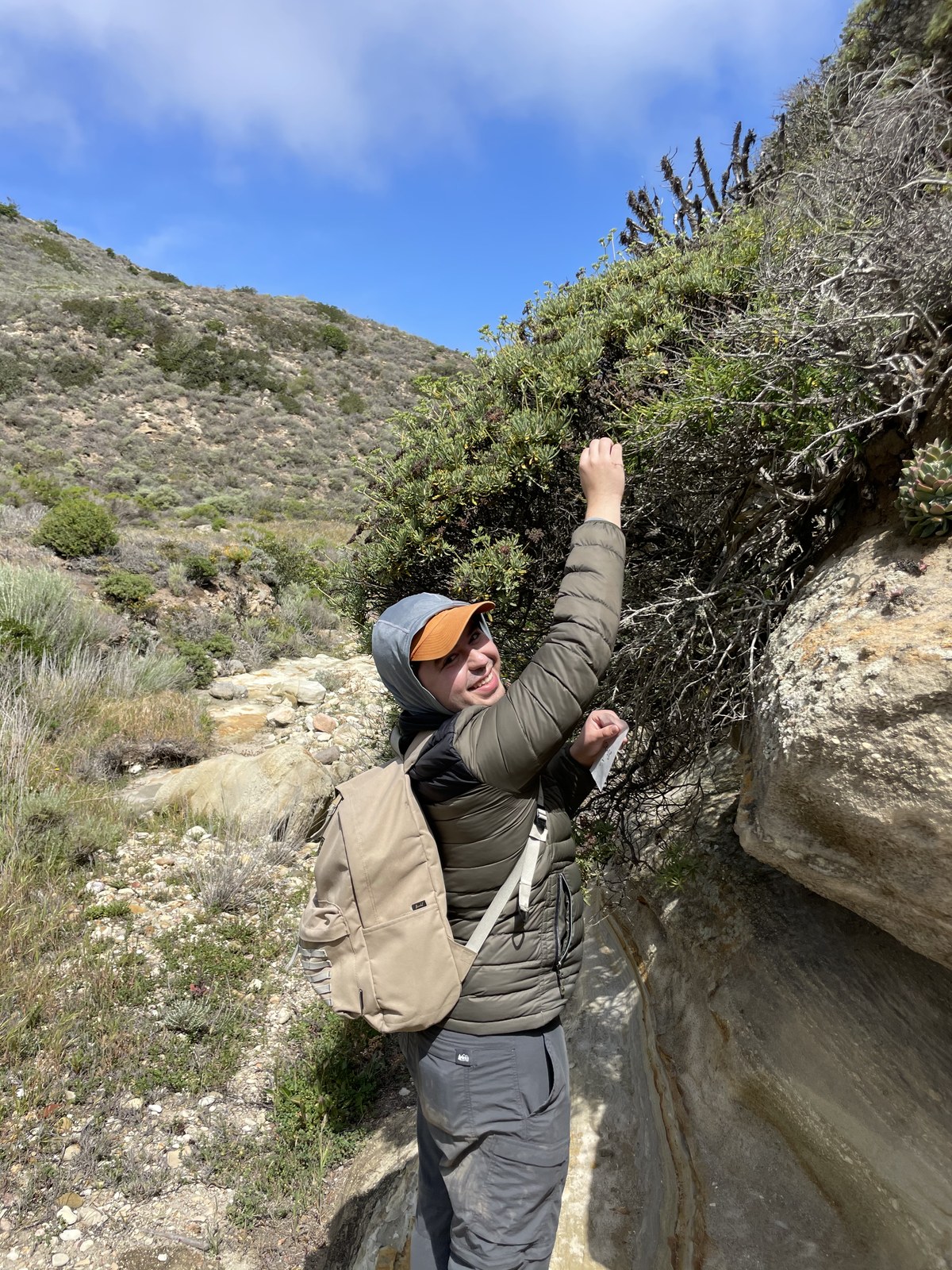
Fieldwork on Santa Rosa Island
Visited the Channel Islands with Dr. Sula Vanderplank, sampling the island endemic sage Salvia brandegeei for ongoing evolutionary plant ecology research.
PhD Candidate · UC San Diego · Expected 2027
View my GitHubBuilding computational tools for low-coverage population genomics and environmental DNA.
Models genome repetitiveness, coverage, and sequencing error to compute accurate k-mer-based genomic distances from low-coverage genome skims. Published in Genome Biology (2026).
Read paper →Reference-free population genomics with diploid genome skims — extending the genome skimming framework to explicitly model heterozygosity for accessible nucleotide diversity estimation. Preprint Available in BioRxiv 2026.
Read paper →Expectation-maximization approach enabling phylogenetic dating under a categorical rate model, improving accuracy of divergence time estimation. Systematic Biology (2024).
Read paper →Collaboration with the Field Museum and Minderoo Foundation to improve detection of environmental DNA for population health tracking and marine species conservation.
I'm a PhD Candidate in Bioinformatics & Systems Biology at UC San Diego, working in the Mirarab Lab. My research focuses on building reference-free, alignment-free genomic tools that make population genomics accessible without expensive references and high coverage, and modeling how complex genome characteristics (such as repetitiveness and diploidy) interact with and bias the Jaccard Index.
I am also in active collaboration with the Field Museum and the Minderoo Foundation to develop environmental DNA methods for population monitoring and conservation.
ReSkmer: modeling repeats allows k-mer-based alignment-free methods to calculate population genomic distances
Genome Biology
doi →Expectation-maximization enables phylogenetic dating under a categorical rate model
Systematic Biology, 73(5): 823–838
doi →Alignment-Free Population Genomics: Handling Repeats and Diploidy in Genome Skims
Molecular Evolution in the Era of Genetic Diversity Decline Symposium @ SMBE · Copenhagen, Denmark
Flash Talk View presentation →Modeling Heterozygosity in Genome Skims Allows for Accessible Population Genomics through Alignment-Free, Assembly-Free Estimation of Nucleotide Diversity
Jacobs School of Engineering: Research Expo · San Diego, California
Poster View poster →ReSkmer: Modeling Repeats Improves Low-Coverage, Alignment-Free Estimates of Genomic Distance
Institute for Mathematical and Statistical Innovation · Chicago, Illinois
Poster View poster →Updated Skmer Improves Reference- and Alignment-Free Population Genomics
Genome Skimming Symposium @ Botany· Palm Springs, California
Invited Talk: Oral Presentation View presentation →Genome Skimming Workshop
Field Museum, Grainger Bioinformatics Center · Chicago, Illinois
Invited Talk: Workshop2023
Field Museum Fellowship: Grainger Bioinformatics Center
2022
San Diego Match Fellowship
2021
Initiative for Maximizing Student Development (NIH)
June 2026
Our new method for reference-free population genomics with diploid genome skims is now up on bioRxiv. It extends the genome skimming framework to explicitly model heterozygosity, making nucleotide diversity estimation accessible without assembly. Read the preprint →
March 2026
Excited to share that ReSkmer is out. By modeling genome repetitiveness, it lets k-mer-based, alignment-free methods calculate accurate population genomic distances even from repetitive genomes. Read the paper →
March 2022
Visited the Channel Islands with Dr. Sula Vanderplank, sampling the island endemic sage Salvia brandegeei for ongoing evolutionary plant ecology research.